
Owls and Olives
Owls and Olives… and why they matter.
When we set out to fund a conservation project through the sale of olive oil, we weren’t sure how to explain why a small grove on a Catalonian hillside mattered enough to ask people to care. Here’s why.
The little owl — Athene noctua — has lived alongside Mediterranean farming communities for thousands of years, nesting in old walls and hollow trees. They eat large numbers of insects and small mammals, naturally controlling populations that would otherwise become pests to farmers — a quiet service traditional agriculture has relied on for centuries.
But it’s a species in real trouble. It has experienced one of the steepest population declines across its entire European range over the last sixty years, with several local populations disappearing entirely, earning it status as a high conservation priority. The cause is familiar: the same agricultural modernization reshaping farmland everywhere. Hedgerows, isolated trees, dry-stone walls, and non-chemical fertilizers — once standard features of traditional farming — have been steadily erased, taking little owl habitat with them. Prey availability, nest site loss, and human habitat destruction are the main drivers.
It’s happening in our region of Catalonia, too. The little owl’s distribution has measurably contracted in recent decades. Researchers studying coastal Catalonia have found that low-intervention farming — exactly the kind we’re restoring — is what preserves good habitat where it still survives.
The little owl is what conservationists call a flagship species: small enough to be charming, loud enough to be noticed, and beloved enough that people will actually do something on its behalf. Nobody organizes a fundraiser for soil fungus, however ecologically vital it might be. But an owl — fierce, funny-sounding, named after a goddess — turns out to be exactly the kind of creature people will rally around. And the genuinely good news is that protecting habitat good enough for little owls means protecting habitat good enough for almost everything else living alongside them.
The good news doesn’t stop there: little owls respond to help quickly. Nest boxes suited to the species have measurably boosted numbers wherever they’ve been installed, making this exactly the kind of small, practical intervention that works. So that’s our plan, in three parts.
First, nest boxes — not just for our own grove, but for the valley as a whole. We have designed and built a couple of prototypes, and this year a little owl couple chose one as its home and raised a family in it. Now we want to help fund and install them for neighbours, smallholders, and local school groups. More boxes scattered across the valley means more chances for owls to find a home, and more people with a personal stake in whether they thrive.
Second, a webcam inside one of our nest boxes, open to anyone who wants to watch. Partly this is for us — we’re hopelessly nosy about what goes on in there. But mostly it’s for everyone else: neighbours down the valley, and people much further away who’ve supported this project, all watching the same small, ridiculous bird raise its family in real time. Conservation is much easier to care about when you can actually see what you’re conserving.
Third, and most importantly for the long term: a proper scientific population survey of all the owls in our valley — not just the little owls, but the larger owls we hear at dusk too. We want a real baseline, gathered properly, so that a year from now, and five years from now, we can say with some confidence whether the population here is holding steady, recovering, or still declining — rather than just guessing based on how many we happen to hear from the terrace some evening.
Proceeds from every bottle sold and every donation made goes directly into this work — giving little owls somewhere to nest, hunt, and raise their young the old way, pesticide-free and low-intervention, in thoughtfully placed nest boxes, watched over by a quietly devoted wildlife camera or two.
We’re not under any illusion that one small grove changes a continent-wide trend. But it could change this valley – thanks to your support.
May 2026
We arrived back in Canada with a crate of amazing olive oil. We’re hosting an Owls and Olives fundraising event in June, where we’ll be selling oil to raise funds for little owl conservation.
The Making of Our Early-Harvest Farga–Empeltre Blend
This oil is an early-harvest blend of two of northeastern Spain’s oldest native olive varieties — Farga and Empeltre — picked well before full ripeness to capture maximum intensity, aroma, and polyphenol content rather than maximum yield.
Grown the Old Way, in southern Catalonia
The olives behind this oil come from a small grove in valley close our grove, tended by a couple who grow mainly Farga, with some Empeltre, on just a few hectares. Theirs is a low-intervention approach in the traditional sense: no irrigation, no synthetic chemicals, no fertilizers — the trees are left to draw on rainfall and the natural resilience these varieties are known for. By any practical measure, this is organic farming. It simply isn’t certified as such, since formal organic accreditation carries a cost that isn’t realistic for a grove this size. What you’re tasting is the result of careful, hands-on, small-scale growing rather than a label on a bottle.
What “Extra Virgin” Actually Means
Extra virgin olive oil is the highest quality grade an olive oil can achieve. It must be extracted using only mechanical methods — no heat, no chemical solvents — and must meet strict thresholds for acidity, peroxide value, and sensory quality, with zero defects detectable by a certified tasting panel. In short: it is the pure juice of the olive, separated from water and solid matter by physical means alone.
Modern Oil Pressing: The Double Centrifuge Method
This oil is produced using a modern double centrifuge extraction process, a meaningful step up in quality from older, traditional milling methods. After the olives are crushed into paste, the paste passes through a first centrifuge that separates the oil-water mixture from the solid pulp and pit fragments, then through a second centrifuge that separates the oil itself from any remaining water. This two-stage approach gives much finer control over separation than older press-based methods, resulting in a cleaner, more stable oil with fewer impurities carried through to the final product.
Cold-Pressed, By Definition
Throughout the entire milling and extraction process, temperatures are kept below 28°C (82°F). This is what “cold pressed” actually means — it is not a marketing term, it is a technical limit. Heat speeds up extraction and increases yield, but it also destroys the volatile aromatic compounds and degrades the polyphenols responsible for an oil’s flavor, aroma, and health properties. Staying under this threshold protects everything that makes early-harvest oil worth making in the first place.
Settling in a Conical Stainless Steel Tank
Immediately after extraction, the oil is transferred into a stainless steel tank with a conical bottom. Over the days that follow, the natural sediment still suspended in the freshly milled oil — fine olive particles and residual moisture — settles down into the cone, where it is drained off and separated from the clear oil above.
This step matters more than it might seem. Freshly milled oil is naturally turbid, or cloudy, and in the short term that cloudiness can actually taste good — fresh, intensely green, almost vegetal. But left in contact with the oil over time, that same sediment ferments and breaks down, introducing off-flavors and defects that degrade the oil’s quality. Draining it off early is what allows the oil to keep its clean, true character rather than developing those faults later on.
Protecting the Oil from Oxygen
The final and ongoing safeguard is oxygen control. The headspace at the top of the storage tank is filled with inert argon gas, displacing the air so that the oil’s surface has no contact with oxygen. This matters because oxidation is the single biggest threat to a freshly milled oil’s quality over time — it is what causes oils to turn rancid, lose their aromatic complexity, and degrade in flavor the longer they sit. Argon, being inert, simply sits above the oil as a protective blanket without reacting with it in any way.
The oil is then stored at cellar temperature — cool and stable, away from heat and light, which slows down any chemical degradation that could still occur even with oxygen excluded.
At bottling, the same principle carries through: the oil is filled into metal cans, which also receive a top-up of argon gas before sealing. This means the oil is shielded from oxygen at every stage, from the moment it leaves the centrifuge to the moment the can is opened — preserving the freshness, aroma, and polyphenol content that early harvesting and cold extraction worked to capture in the first place.
Varietals:
Farga
This one of the more fascinating olive varieties out there — genuinely tied to living history in a way few cultivars are.
History Farga is native to the north of Castellón province in Spain, with cultivation extending into the Baix Maestrat area and south into Tarragona, where it represents more than 70% of the total olive growing surface area in that region. It’s considered the oldest olive variety in the region, and the trees themselves can be staggeringly old — the most famous individual specimen, La Farga de Arión in Ulldecona (Tarragona), is considered the oldest olive tree in Spain, reportedly planted in the year 314, making it over 1,700 years old. Some certified Farga trees in the Sénia Territory have survived fires, frosts, droughts, and pests for over a thousand years, and producers in the area have built entire premium-oil brands around this living heritage — labeling bottles “Millennial Oil” or similar, tied to specific certified ancient trees.
The variety is now in commercial decline: the tree’s vigorous growth and hard-to-harvest large crown mean no new Farga plantations have been made in over 100 years, as growers shifted to more productive, easier-to-harvest varieties like Picual, Arbequina, and Empeltre. So what survives today is largely legacy groves, not new plantings — which is part of why the “ancient tree” marketing angle is so central to how Farga oil is sold now.
Taste profile Farga EVOO has an early, medium bitter and spicy taste, well defined and persistent in the mouth, with a highly fruity aroma reminiscent of freshly cut grass, almonds, or green nuts. Other tasting notes mention green banana, tomato, and artichoke notes, with a tendency toward a well-balanced oil between sweet, bitter, and spicy, finishing with a slight final astringency. Some producers also describe notes of green walnuts and green apple skin.
Chemical/technical properties
- Medium oleic acid content around 70% (other sources put it slightly higher, around 72%, with linoleic acid around 11%)
- Highly stable oil with medium to high polyphenol content, rich in apigenin; total sterols medium-low, with β-sitosterol the most abundant
- Medium oil stability overall
Growing peculiarities Farga is a genuinely difficult variety to farm commercially:
- Production is low and alternates significantly year to year, makes it even less productive; the start of production is late in the season, though ripening and clustering happen early
- It’s andro-sterile (can’t self-pollinate) and the fruits have high holding force, making mechanized harvesting difficult
- It’s a rustic variety, slow to start production and sensitive to frost; the high fruit retention force combined with the large tree size makes both manual and mechanical harvesting difficult
- It’s resistant to tuberculosis (a plant disease) but sensitive to repilo, Colletotrichum, and Verticillium
- The fruit itself has low fat content, resulting in low oil yield — meaning even when you get a good harvest, you get comparatively little oil per kilo of olives versus higher-yield varieties
Uses The characteristics of the Farga olive make it suitable only for oil production — it’s not used as a table olive. The oil itself is positioned firmly in the premium/gourmet tier: it has good organoleptic characteristics increasingly appreciated by the gourmet olive oil sector, and it’s considered very interesting either as a standalone varietal oil or as a component in blends, with good storage potential especially when harvested early. It’s often blended with the Morrut variety to balance flavor profiles. Recommended culinary pairings lean toward raw/finishing applications — drizzled raw over steak tartare, dried meats, seafood, or as a finishing touch on dishes like elvers — rather than cooking oil use, which makes sense given the price point.
Price and rarity This is the real peculiarity: Farga oil from certified ancient trees commands genuinely high prices — some oils extracted from millenary, protected olive trees carry exorbitant prices exceeding €100 per liter. It’s also notably low-yield as a variety, which compounds the scarcity. It carries PDO (Protected Designation of Origin) status under the Baix Ebre-Montsià PDO, tying it formally to its growing region the way Champagne or Parmigiano-Reggiano are protected.
The short version: Farga is essentially the opposite of a modern, optimized commercial olive — it’s a low-yield, hard-to-harvest, disease-susceptible variety kept alive almost entirely because some of its surviving trees are genuinely ancient, and that heritage (plus a distinctive grassy-almond-bitter flavor profile) has carved out a niche luxury market that productivity alone would never justify.
Empeltre
This is a great counterpoint to Farga — both ancient and northeastern Spanish, but with a much gentler, more crowd-pleasing personality and a far stronger commercial footing.
History and name origin Empeltre is genuinely old — it’s a traditional Spanish variety with more than 500 years of documented history, with records dating back before the 15th century. The name itself tells you something important about how it’s propagated: “Empeltre” translates to “grafted” in Catalan, reflecting the propagation technique used for this olive variety, and this isn’t incidental — the variety has low rooting capacity, which requires grafting as the main propagation method; in fact, its name seems to derive from the Catalan word “empelt,” meaning graft, since this variety was historically grafted onto older trees.
Where it’s grown Empeltre is grown mainly in the regions of Baleares and Aragón, with cultivation extending into Castellón, Tarragona, Navarra, La Rioja, and the Balearic Islands. Depending on the area, it goes by a few local names — it’s also known as “Aragonese” or “Mallorquina” depending on cultivation area. Total Spanish cultivation sits at roughly 80,000 hectares, which is a meaningfully larger footprint than Farga’s ~14,000-21,000 hectares — though Empeltre still only represents about 3-4% of Spain’s national olive groves, or by another estimate around 1% of world olive oil production. It’s also made the jump overseas: internationally, plantations exist in Argentina, specifically in Mendoza and Córdoba.
Tree and fruit characteristics
- Large trees with upright branches and a vertical-tending treetop, with dark, shiny green leaves that have a silver underside and a prominent green nerve
- Olives are jet black, ripening early — anytime from the first week of October through the first week of December depending on region
- Olives are long, asymmetrical, slightly curved on the back, averaging about 2.7 grams with a pulp-to-pit ratio of 5:3
- It’s a rustic variety that adapts well to poor terrain and tolerates drought
- Tolerates verticillium wilt and anthracnose well, but is sensitive to the olive fruit fly and cochineal scale insects
- It’s productive but alternates year to year, enters production late, but the fruit has low resistance to detachment — which actually helps mechanized harvesting (a nice contrast to Farga, whose high fruit-retention force makes harvesting a pain)
Taste profile
This is where Empeltre really differs from Farga’s grassy/bitter/spicy character — it’s known for being mild, sweet, and approachable: Empeltre EVOO has a soft and sweet taste with fruity aromas, and the oil’s flavor is notably less intense than varieties like Picual, Hojiblanca, Cornicabra, or Arbequina. It’s described as a yellow-colored, smooth oil that’s sweet and aromatic with no bitterness at all in some characterizations. Other sources note more nuance: aromas of medium-high intensity reminiscent of fresh grass, tomato, and artichoke, with characteristic fennel notes, smooth on the palate, well balanced with medium intensity bitter, spicy, and sweet highlights. One producer’s profile leans more savory: an intense fruity oil with green and ripe notes, bitter and spicy in the mouth with a final astringency, balanced by a clear underlying sweetness, and secondary nutty aromas.
Interestingly, ripeness timing shifts the flavor noticeably: at the start of the harvest, the oil has a fruity taste reminiscent of the olive tree itself, but as the olive ripens further on the tree, the resulting oil becomes slightly sweet, without bitterness or pungency. So Empeltre is one of those varieties where harvest timing meaningfully changes the final character — early harvest gives more green fruitiness, late harvest gives the smooth, sweet profile it’s best known for.
Oil yield and chemistry Empeltre is notably productive for oil: oil yield runs 18.3%-27%, with a pale yellow to golden hue — a real contrast to Farga’s low-fat, low-yield fruit. This higher yield, combined with easier mechanized harvest, is a big part of why Empeltre has thrived commercially while Farga has declined.
Culinary uses Empeltre is genuinely versatile — used both as a table olive and for oil: it can also be used for dressing in black, though its pulp-to-bone ratio places it below other varieties for that purpose. As an oil, its mildness makes it a flexible all-rounder: ideal for raw use, especially in mild salads, white fish, cooked vegetables, mayonnaise, homemade sauces, and pastries, and equally good for daily cooking thanks to its smoothness and stability, enhancing flavors without overpowering them. Another source recommends it similarly for salads, seafood, and baking. This is a meaningful contrast with Farga, which leans toward raw, finishing-only applications — Empeltre is the more everyday, kitchen-flexible oil of the two.
Protected status Like Farga, Empeltre carries PDO protection — most notably the Aceite del Bajo Aragón PDO, and regionally also under the DOP Terra Alta, where it’s the dominant variety in towns like Vilalba dels Arcs at 60-70% of local production area.
Bottom line comparing the two: if Farga is the rare, hard-to-farm, intensely bitter-grassy “heritage trophy” oil mostly used as a luxury finishing touch, Empeltre is the more practical, high-yielding, genuinely ancient workhorse variety — sweet, mild, versatile in the kitchen, and commercially thriving rather than declining. Given you’re clearly developing a real interest in Spanish olive varietals, want me to run through one more — maybe Morrut, since it kept showing up paired with Farga in blends, or Arbequina, which is probably the most internationally recognizable Catalan variety?

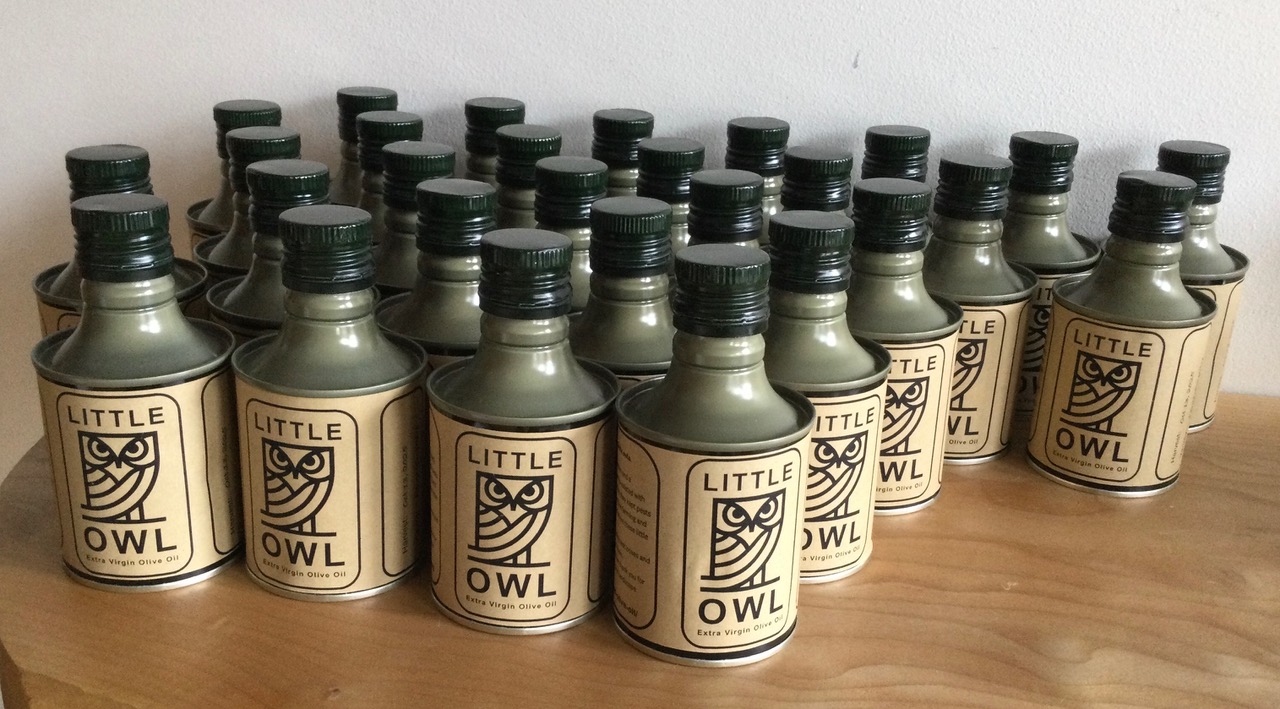
Little Owl Olive Oil is bottled and ready to be sold as a fundraiser. Light and oxygen exposure are two things that degrade olive oil. We have topped up every bottle with inert argon gas so the oil never comes in contact with oxygen and the metal containers prevent exposure to light. As a result this organic extra virgin oil keeps its flavour and health benefits.

Little Owl Olive Oil is bottled and ready to be sold as a fundraiser. Light and oxygen exposure are two things that degrade olive oil. We have topped up every bottle with inert argon gas so the oil never comes in contact with oxygen and the metal containers prevent exposure to light. As a result this organic extra virgin oil keeps its flavour and health benefits.

We’re pumped! Little Owls raised a family in the nest box I built for them a couple of years ago. I never saw any signs of them on the outside so I assumed it had never been used but when I opened it there were a lot of bits of white egg shells inside.
We’re pumped! Little Owls raised a family in the nest box I built for them a couple of years ago. I never saw any signs of them on the outside so I assumed it had never been used but when I opened it there were a lot of bits of white egg shells inside.
Bottling our olive oil to take back to Canada. We love this stainless steel storage tank. Once it’s filled, we put Argan gas into it so there is no contact with oxygen. Also the conical bottom allows us to separate out sediment which makes for a better tasting oil.
Bottling our olive oil to take back to Canada. We love this stainless steel storage tank. Once it’s filled, we put Argan gas into it so there is no contact with oxygen. Also the conical bottom allows us to separate out sediment which makes for a better tasting oil.
Wild tulips (Tulipa Sylvestre) are having a bumper year due to all the rain. They are natives of southern Europe and Morocco however they aren’t the ancestors of our cultivated tulips. I couldn’t find any traditional uses for this species.
Wild tulips (Tulipa Sylvestre) are having a bumper year due to all the rain. They are natives of southern Europe and Morocco however they aren’t the ancestors of our cultivated tulips. I couldn’t find any traditional uses for this species.
We spotted the first mirror orchids of the season a few days ago. They masquerade as a female wasp in order to attract males who will then pollinate them!
We spotted the first mirror orchids of the season a few days ago. They masquerade as a female wasp in order to attract males who will then pollinate them!
The heather in the surrounding hills is in full bloom at the moment.
Just finished the last of the harvest. Heavy rain storms in the previous week knocked most of the olives to the ground however, we were able to get another 50 kg. Half of those olives came from Claire (we named all our trees!)
Just finished the last of the harvest. Heavy rain storms in the previous week knocked most of the olives to the ground however, we were able to get another 50 kg. Half of those olives came from Claire (we named all our trees!)
This crazy DANA weather system has been hanging over us for weeks here in Catalunya. Luckily we’ve been spared the extremes that decimated communities to the south and north of us. There is not much wind but tons of rain, thunder and lightning. The skies always have an ominous, apocalyptic look. Everything feels moist and clammy. Even though it’s quite warm we light a fire occasionally just to drive out the dampness. Luckily we harvested a good amount of olives before this started.
This crazy DANA weather system has been hanging over us for weeks here in Catalunya. Luckily we’ve been spared the extremes that decimated communities to the south and north of us. There is not much wind but tons of rain, thunder and lightning. The skies always have an ominous, apocalyptic look. Everything feels moist and clammy. Even though it’s quite warm we light a fire occasionally just to drive out the dampness. Luckily we harvested a good amount of olives before this started.


